
A Guide to Medical Waste Disposal
The operation of modern healthcare facilities generates one of the world’s most heavily scrutinised and hazardous waste streams, making medical waste disposal a critical pillar of public health and safety. Far from being general refuse, this material requires highly specialised management, serving as a direct indicator of a facility’s commitment to safety, environmental integrity, and legal compliance. It is the vital, final step in the cycle of care that shields workers, patients, the public, and the environment from infectious, chemical, and physical harm.
The sheer volume and diversity of waste from hospitals, clinics, and laboratories present an ongoing global challenge. As the healthcare sector expands, the need for robust, compliant, and sustainable medical waste disposal practices becomes even more urgent, necessitating adherence to stringent national and international guidelines to mitigate inherent dangers.
Defining the Hazard: Classification and Risk
Identifying and separating medical waste at its source is the single most crucial step in effective and safe management. This process, known as segregation, dictates the entire lifecycle of the waste, ensuring that hazardous materials receive the correct, often high-heat, treatment, while non-hazardous materials do not unnecessarily inflate disposal costs or risk contaminating the environment. Experts stress that correct segregation at the source is the most vital safety measure, as errors like mixing sharps with general waste directly increase occupational injury risks and lead to substantial non-compliance penalties.
Medical waste is officially defined as any material contaminated by potentially infectious or otherwise hazardous agents generated during human or animal health activities. Its designation is crucially determined by its point of origin and its composition. Understanding the different categories is paramount to ensuring that the correct treatment technology is applied, which protects personnel and meets the strict sterility benchmarks, such as a log 6.5 reduction, required by regulators.
- Infectious Waste: This typically includes items saturated with liquid or semi-liquid blood or other potentially infectious materials (OPIM), such as used dressings, swabs, gloves, and personal protective equipment (PPE). Data from specialised treatment facilities indicates that infectious waste frequently accounts for over 90% of the total volume processed.
- Sharps Waste: Needles, syringes, and blades represent the greatest risk for occupational injury and infectious disease transmission. Hospital personnel commonly make errors, such as mixing sharps with general infectious waste, which directly increases non-compliance and danger.
- Pathological Waste: Anatomical waste, including tissues and organs, requires extreme heat destruction due to its biological nature. In South Africa, such waste streams must be incinerated and cannot be processed via less intense thermal methods.
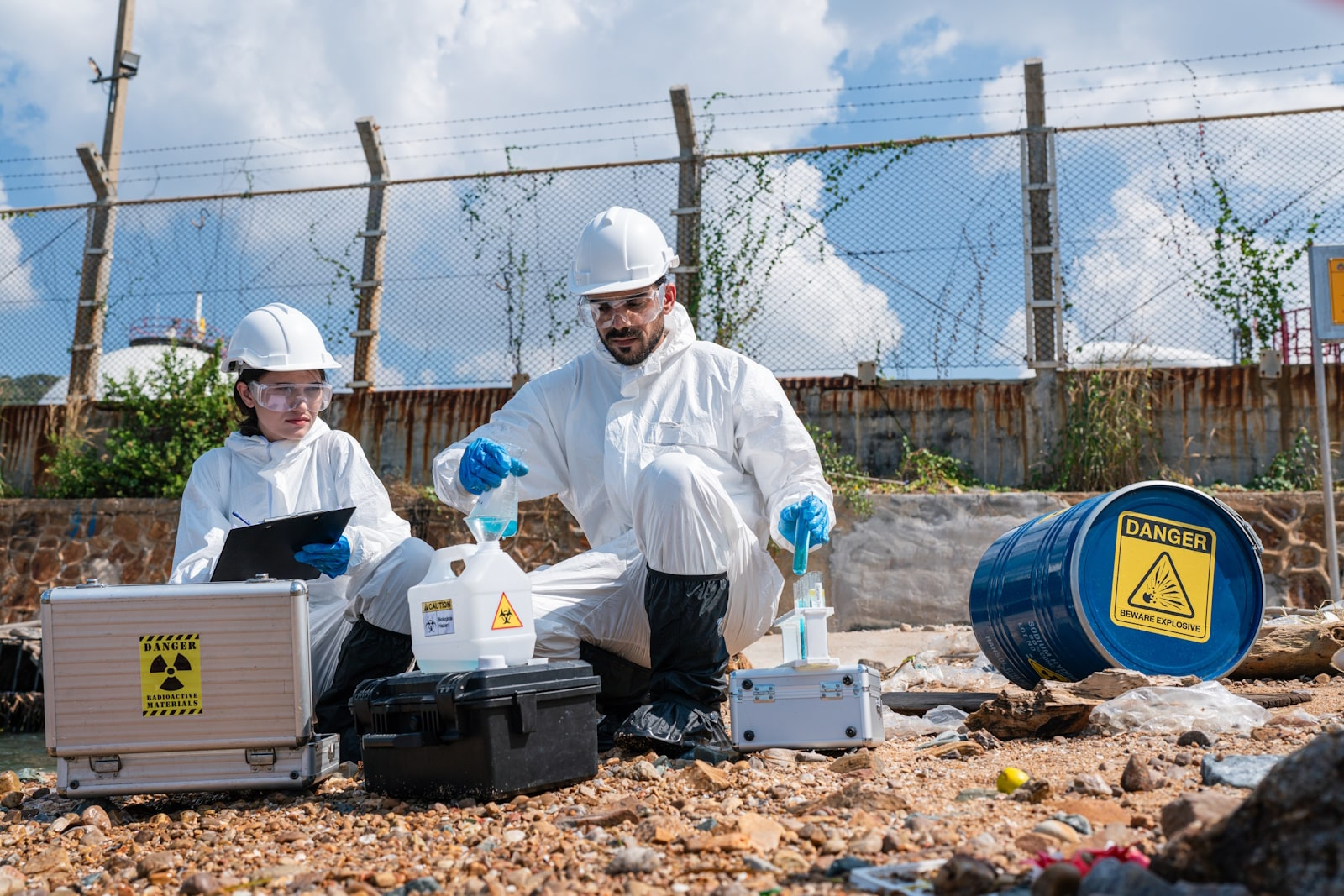
- Radioactive Waste: Materials contaminated by radioactive isotopes from nuclear medicine. For facilities handling this, specialised screening tools like a Geiger counter are deployed to measure radiation levels and flag any waste exceeding the permitted thresholds, ensuring immediate isolation and expert medical waste disposal.
This classification system forms the foundation of a compliant waste management program. Failure to adhere to the colour-coded and container-specific rules for each type of waste exposes waste handlers and the public to pathogens, chemicals, and radiation.
Therefore, facilities must implement rigorous training and monitoring protocols to maintain safety. The integrity of the entire medical waste disposal process hinges on this initial sorting, confirming that all materials are correctly identified and safely contained before they leave the premises.
The Legal Imperative: Compliance in South Africa
Medical waste disposal is governed by comprehensive, stringent legislation. South African regulations are particularly demanding, treating medical waste as one of the most tightly controlled waste streams in the country, with severe penalties for non-compliance.
The legal framework is driven by environmental laws, including those enforced by the Department of Forestry, Fisheries and the Environment (DFFE), whose mandate is rooted in Section 24 of the Constitution, which guarantees everyone the right to an environment that is not harmful to their health. The responsibility for the waste, known as the ‘cradle-to-grave’ approach, rests firmly with the generator, such as the hospital or clinic. Failure to correctly segregate, store, or document waste management procedures not only poses a public health risk but also exposes institutions to steep fines.
The Disposal Pathway: Treatment and Destruction
Once correctly segregated, medical waste embarks on a tightly controlled pathway to render it non-hazardous. The industry’s standard for confirming the elimination of pathogens is the sterility assurance level, typically requiring at least a log 5 reduction in microbial load, though many advanced technologies exceed this, achieving a log 6.5 reduction.
Treatment technologies fall into two main categories: Thermal Destruction and Non-Incineration Technologies. Incineration remains a necessary method for high-risk pathological and certain pharmaceutical waste, as it dramatically reduces volume by at least 90% and provides complete destruction. However, due to past environmental concerns, cleaner thermal alternatives are increasingly favoured.
Non-Incineration methods include Autoclaving, which uses pressurised steam to sterilise infectious waste, and is now the dominant method globally. A more modern and sustainable alternative is Electrothermal Deactivation (ETD), an advanced process where infectious waste is shredded and sterilised using heat generated by electricity. Experts confirm that these ETD systems are highly effective, achieving the required sterility assurance without the carbon dioxide emissions associated with traditional incineration, thus setting a high standard for responsible medical waste disposal.
Emerging Trends and Modern Management Systems
The future of medical waste disposal is being fundamentally reshaped by technological innovation and a global push toward greater sustainability. The worldwide medical waste management market is projected for significant growth, a trend driven by increasing volumes of waste, stricter regulatory requirements, and a public demand for environmental accountability from healthcare providers. This necessitates a move away from conventional practices towards digitally integrated and greener solutions that can simultaneously enhance safety and efficiency.
These emerging technologies are not simply incremental improvements; they represent a paradigm shift towards intelligent, verifiable, and low-impact waste management systems. These innovations aim to make the entire ‘cradle-to-grave’ process fully transparent, moving beyond paper-based tracking to secure, real-time digital monitoring.
- Digital Tracking and Automation: The use of advanced technology, such as AI-powered scanners and in-house monitoring systems, is becoming standard practice. These tools can automatically detect anomalies in waste bags, such as metal implants or non-compliant anatomical waste, and flag them for immediate redirection to the correct treatment stream, significantly enhancing safety and regulatory adherence.
- Sustainability: Industry efforts are focusing on waste minimisation at the source, adopting reusable items, and embracing treatment methods that are kinder to the environment. This includes the move to advanced, non-incineration technologies that achieve high-level sterilisation while eliminating the air quality concerns associated with traditional thermal methods.
- Intelligent Logistics: The integration of Internet of Things (IoT)-enabled smart bins and intelligent routing is optimising collection schedules and capacity management, leading to more efficient logistics and reduced operational costs for generators.
These modern systems are fundamentally changing the industry’s risk profile, effectively placing a digital shield around the medical waste disposal process. By automating compliance checks and real-time tracking, these innovations help prevent the human errors that traditionally lead to environmental contamination or occupational exposure.
Ultimately, the goal of these emerging trends is to create a closed-loop system where public health protection and environmental stewardship are seamlessly integrated. Investing in these advanced, verifiable solutions is the key to managing the increasing complexity and volume of regulated waste generated by the healthcare sector.
A-Thermal: Specialists at Medical Waste Disposal
The safe and compliant management of medical waste remains a complex, demanding field that requires expertise, diligence, and investment in cutting-edge technology. It is a vital service that safeguards human health and environmental integrity against the hazards generated daily by healthcare activities, affirming that responsible medical waste disposal is crucial to a sustainable healthcare sector.
A-Thermal provides the healthcare industry with a comprehensive, one-stop medical waste treatment and medical waste disposal service, prioritising customer care, safety, and regulatory compliance. Our expertise encompasses two primary treatment methods: high-temperature burn technology using a kiln to fully oxidise waste like anatomical streams into inert ash, and non-burn technology (autoclave). This environmentally friendly autoclaving process uses high-pressure steam for complete sterilisation of most health care risk waste (HCRW), including infectious and sharps waste, which is then shredded as per local legislation to render it unrecognisable before final medical waste disposal. We ensure all our practices and documentation strictly adhere to local, regional, and national regulations.
As the sector evolves, modern treatment facilities continue to adopt state-of-the-art systems to ensure that our medical advancements do not come at the expense of our planet. At A-Thermal, we utilise industry-leading thermal and non-thermal destruction processes, including advanced incineration and state-of-the-art Electrothermal Deactivation (ETD) technology, to provide fully compliant, cradle-to-grave solutions for all regulated waste streams. Contact us today to learn how our comprehensive services can partner with you to achieve seamless and safe waste management.